Stonewall Pebbles: Timeless Texture Meets Modern Design Workflow
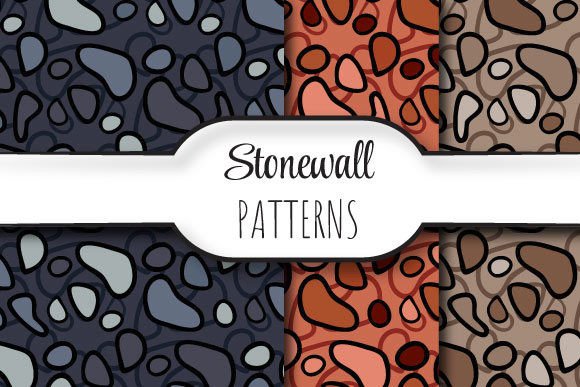
Stonewall Pebbles isn’t just another background pattern—it’s a tactile echo of natural erosion, translated into a precision-engineered, seamlessly repeating vector design. At its core, it captures the quiet rhythm of weathered stone: irregular yet balanced, organic yet structured, grounded yet versatile. Each file delivers a 12 × 12 inch canvas—3600 × 3600 pixels at true 300dpi resolution—ensuring crisp fidelity whether printed on stationery, packaging, or large-format wall graphics. The inclusion of one EPS 10 file alongside three high-res JPEGs (RGB, CMYK, and grayscale) reflects a deliberate response to how professionals actually work today: cross-platform, cross-purpose, and cross-discipline.
Why Seamless Repeating Patterns Are No Longer Optional
Seamlessly repeating vector patterns like Stonewall Pebbles have shifted from niche decorative tools to foundational assets in visual communication. Designers no longer treat backgrounds as afterthoughts—they’re strategic layers that shape tone, reinforce brand identity, and guide attention. A well-chosen pattern can soften digital interfaces, add depth to print collateral, or unify multi-channel campaigns without relying on photography or illustration. Unlike raster-based repeats—which blur or pixelate when scaled—vector-based seamless patterns retain edge-to-edge integrity at any size. That means Stonewall Pebbles works equally well as a subtle watermark on a PDF report, a full-bleed backdrop for a trade show banner, or a tileable surface for 3D mockups in Adobe Substance or Blender.
This shift aligns with broader workflow changes: faster turnaround times, tighter budgets, and increased demand for asset reusability. Marketing teams repurpose one pattern across email headers, social media templates, and presentation decks. Educators embed it into printable worksheets and slide decks without worrying about licensing or resolution limits. Freelancers build custom brand kits for clients—and include scalable, editable patterns like Stonewall Pebbles as part of their deliverables, not as an upsell.
From Hand-Drawn Motifs to Precision Vector Tiles
The evolution of seamless patterns mirrors advances in both design software and user expectations. Early digital repeats often suffered from visible seams, inconsistent spacing, or limited color adaptability. Today’s standards demand invisibility—the viewer should sense texture and rhythm, not registration lines or tiling artifacts. Stonewall Pebbles meets this standard through careful anchor-point placement, balanced negative space, and intentional variation in pebble scale and density. It avoids the “too-perfect” uniformity of algorithmic tiling, instead mimicking how real stonework settles over time: clustered in some areas, sparse in others, never mechanical.
This attention to human perception matters. Studies in visual cognition show that viewers process repeated textures more efficiently than complex imagery—making them ideal for environments where clarity and calm are priorities, like healthcare branding, educational materials, or wellness-focused websites. Stonewall Pebbles’ neutral tonal range and soft contrast support accessibility guidelines without sacrificing character, while its vector foundation allows effortless recoloring in Illustrator or Figma to match evolving brand palettes.
Practical Use Cases Across Roles and Real Workflows
For business owners launching physical products, Stonewall Pebbles offers immediate utility. Imagine using the CMYK JPEG for packaging labels—its 300dpi resolution ensures clean halftone reproduction on uncoated stock. Or embedding the EPS file into a dieline template to preview how the pattern wraps around a soap box or notebook cover. Because it’s vector-based, you can adjust scale, rotate orientation, or apply transparency masks without degradation—no need to request revised files from a designer every time a layout shifts.
Bloggers and content creators benefit too. The RGB JPEG integrates smoothly into Canva, Figma, or WordPress block editors for featured image backdrops or newsletter banners. Its muted warmth adds visual interest without competing with text—unlike bold photographic backgrounds that risk overwhelming readability. And because the pattern is inherently non-distracting, it supports focus on written content, which aligns with current audience preferences for clean, distraction-free reading experiences.
Educators use it to create consistent, professional-looking handouts and classroom posters. The grayscale JPEG serves double duty: perfect for photocopying without tonal loss, and ideal for accessibility-focused documents where color contrast must meet WCAG 2.1 AA standards. Seamlessly repeating patterns also reduce cognitive load—students recognize recurring visual cues (like a consistent header texture) as signals of structure and reliability.
File Format Choices Reflect Real-World Needs
The specific file composition—EPS 10, plus three JPEG variants—isn’t arbitrary. EPS 10 remains widely supported across legacy and modern vector applications, including older versions of CorelDRAW and InDesign, while retaining full editability in Illustrator. It’s the safest choice for print service providers who require predictable output. The JPEGs fill complementary roles: RGB for web and screen use, CMYK for offset printing, and grayscale for monochrome applications or quick prepress checks.
That 12 × 12 inch, 3600 × 3600 pixel dimension is equally intentional. It’s large enough to accommodate bleed and scaling for most commercial print needs—including fabric printing, signage, and stationery—but compact enough to open quickly in lightweight apps. Unlike gigabyte-sized TIFFs or PSDs, this package stays agile. The ZIP delivery format keeps assets organized and transfer-friendly—especially useful for remote teams sharing files via Slack, Dropbox, or WeTransfer.
How Stonewall Pebbles Fits Into Broader Creative Shifts
There’s growing emphasis on authenticity—not as a marketing buzzword, but as a functional principle. Audiences respond to visuals that feel earned, not engineered. Stonewall Pebbles resonates because it references something real: the slow accumulation of time, pressure, and environment. That resonance translates across sectors. Architects use it in mood boards to evoke material honesty. Sustainability-focused brands adopt it to signal natural processes and low-impact aesthetics. Even tech companies integrate it into UI elements to soften digital interfaces and suggest stability amid rapid change.
This aligns with lifestyle shifts toward intentionality. People curate digital spaces with greater care—choosing desktop wallpapers, Notion templates, and email signatures that reflect personal values. Stonewall Pebbles fits naturally into those choices: understated but meaningful, flexible but distinctive. It doesn’t shout; it settles. And in an age saturated with motion graphics, AI-generated art, and hyper-saturated gradients, that restraint carries weight.
Getting Started Without Overcomplicating Things
You don’t need advanced vector skills to use Stonewall Pebbles effectively. Start small: replace a flat-color background in your next presentation slide with the RGB JPEG. Adjust opacity to 10–15% for subtlety. Try applying it as a layer mask in Photoshop to reveal texture only behind key headlines. For print projects, place the EPS file into InDesign and use Object > Clipping Path > Detect Edges if you need to isolate sections.
If you’re building a brand system, test how Stonewall Pebbles interacts with your type hierarchy. Does it enhance legibility—or does it compete? Try pairing it with sans-serif fonts for modern contrast, or serif faces for layered tradition. And remember: repetition doesn’t mean monotony. Rotate the tile 90 degrees, overlay a second instance at reduced opacity, or combine it with a fine line grid for added dimension—all possible because the source is vector and resolution-independent.
Ultimately, Stonewall Pebbles represents a quiet evolution in how we think about reusable assets—not as static decorations, but as adaptable, context-aware tools. It bridges craft and efficiency, heritage and utility, texture and technology. Whether you’re designing a startup’s first business card or refreshing a university’s internal communications, it offers consistency without compromise, character without clutter, and scalability without sacrifice.