Fish Scale Art Deco: Where Geometry Meets Texture in Modern Design
Art Deco never disappeared—it evolved. What began in the 1920s as bold symmetry, sunburst motifs, and stepped skyscrapers has quietly re-emerged in today’s digital workflows—not as nostalgia, but as functional visual language. Fish Scale Art Deco is a precise evolution of that legacy: a bridge between the precision of architectural drafting, the rhythm of natural patterning, and the practical demands of contemporary design tools. It’s not just decorative; it’s engineered for use.
Why “Fish Scale” Fits So Naturally Into Art Deco’s DNA
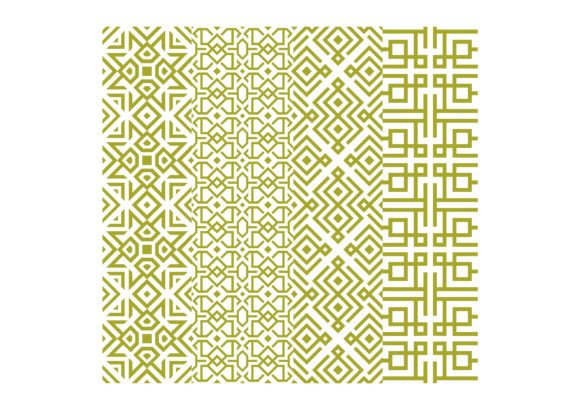
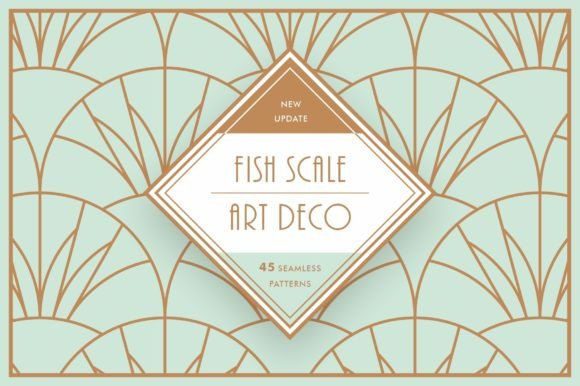
The fish scale motif isn’t new to Art Deco—it appeared in vintage tilework, lacquered furniture, and metal grilles—but today’s reinterpretation is more intentional and versatile. Unlike organic, irregular scales found in nature, Fish Scale Art Deco patterns are mathematically balanced: each unit interlocks cleanly, rotates predictably, and repeats without visible seams. This makes them ideal for vector-based workflows where scalability, editing flexibility, and pixel-perfect tiling matter.
These 45 patterns don’t mimic biology—they abstract it. They borrow the overlapping logic of scales but translate it into clean vectors inspired by geometric classics (think Bauhaus grids and De Stijl alignments), architectural details (ziggurat facades, elevator lobby mosaics, terrazzo inlays), and natural systems (honeycomb efficiency, fern frond unfurling, mineral crystallization). The result feels both grounded and forward-looking—familiar enough to resonate, refined enough to stand out.
Designers Aren’t Just Choosing Styles—They’re Choosing Systems
Today’s creative professionals rarely start from scratch. They assemble, adapt, and iterate—often across platforms, teams, and timelines. That’s why ease of use isn’t a bonus—it’s non-negotiable. A pattern collection must work inside Figma for UI mockups, Illustrator for logo lockups, InDesign for editorial layouts, and even Canva for social assets. It needs to scale from a business card to a billboard without losing fidelity or clarity.
This collection delivers exactly that: 45 tileable patterns in vector EPS and AI formats—fully editable, layer-organized, and built with consistent anchor points and alignment. No hidden raster elements. No embedded fonts or effects that break on export. Each file opens cleanly, resizes infinitely, and adapts to color shifts with predictable contrast. And because every pattern is truly tileable—no awkward edges, no manual offsetting—designers save time on repetition, masking, and troubleshooting.
The inclusion of 45 high-resolution JPG files (3000×3000 px at 300 dpi) adds another layer of utility. These aren’t placeholders—they’re production-ready for print projects: packaging mockups, fabric swatches, stationery proofs, or large-format wall graphics where vector previews don’t reflect final ink behavior. Having both vector and raster options means one collection serves screen *and* surface, concept *and* delivery.
Real-World Use Cases—Beyond Backgrounds
Backgrounds are just the starting point. Fish Scale Art Deco patterns thrive where texture meets intention:
- Branding systems: A subtle scale pattern can reinforce brand identity when applied to email headers, presentation decks, or packaging liners—adding tactile depth without competing with typography or logos.
- Product design: Used as etched motifs on glassware, embossed textures on leather goods, or woven into textile labels, these patterns translate seamlessly from digital mockup to physical product.
- Educational and institutional materials: Universities, museums, and cultural nonprofits often seek visual language that conveys heritage and authority—without feeling dated. Fish Scale Art Deco offers gravitas with modern clarity.
- Web and app interfaces: When used sparingly—as subtle SVG overlays on hero sections or as animated looped textures behind call-to-action buttons—they add dimension without slowing load times.
- Marketing collateral: Trade show banners, lookbooks, and limited-edition product drops benefit from patterns that feel curated, not generic—distinctive enough to be memorable, restrained enough to stay professional.
What sets this collection apart isn’t just quantity (45 patterns), but curation logic. Some emphasize vertical rhythm for tall layouts like posters or Instagram carousels. Others prioritize diagonal flow for dynamic motion in presentations. A subset uses monoline weight and open negative space—ideal for laser-cut stencils or embroidery digitizing. Another group leans into layered transparency, enabling rich color interactions in digital composites.
How Changing Workflows Are Reshaping Pattern Expectations
A decade ago, designers might download a single seamless JPEG and stretch it across a webpage. Today, that approach falls short. Clients expect responsive assets, multi-channel consistency, and version control. Teams using shared design systems need patterns that behave the same way whether opened in Adobe CC, Affinity Suite, or browser-based editors.
That’s why editable vectors matter—not as a technical footnote, but as a workflow necessity. Need to shift the hue for an accessibility-compliant palette? Adjust spacing to match a new grid system? Swap one shape for another while preserving tiling integrity? These aren’t edge cases—they’re daily tasks. The Fish Scale Art Deco collection anticipates them: layers are named logically (e.g., “Base Tile,” “Overlay Accent,” “Color Mask”), paths are simplified but not oversimplified, and swatches follow industry-standard naming conventions.
It also reflects how designers now source inspiration. Instead of flipping through scanned archives or hunting fragmented freebies, they turn to purpose-built toolkits—collections designed around a specific visual principle, tested across real projects, and delivered with clear usage guidance baked into the structure itself.
Not Just for Designers—A Practical Asset for Many Roles
Freelancers pitching to boutique studios appreciate having polished, cohesive pattern options that communicate craft and attention to detail—even before the first revision round. Educators building lecture slides or course handouts find these patterns elevate visual literacy without requiring advanced software skills. Small business owners creating their own Shopify banners or Etsy product photos gain professional polish without hiring a designer for every update.
Even marketers evaluating visual assets for A/B testing benefit: having 45 distinct yet tonally aligned patterns allows for meaningful variation—testing how subtle texture influences perceived premiumness, trust, or engagement—without sacrificing brand coherence.
Looking Ahead—Without Overpromising
Fish Scale Art Deco won’t replace minimalist flat design or generative AI visuals. Instead, it occupies a valuable middle ground: human-crafted, rule-based, and deeply adaptable. Its relevance grows as audiences become more visually literate—and more fatigued by algorithmically homogenized aesthetics. People notice craftsmanship, even when they can’t name it.
That said, its value isn’t in trendiness—it’s in longevity. These patterns avoid fleeting fads: no distressed textures, no forced glitch effects, no unsustainable gradients. They’re built to age well, like the original Art Deco buildings still defining city skylines nearly a century later—not because they’re frozen in time, but because their underlying logic remains sound.
If you’ve ever spent hours adjusting tile offsets, converting raster patterns to vectors, or compromising on resolution for print, this collection solves those quiet frustrations. It doesn’t ask you to change your process—it fits into it, cleanly and consistently. That kind of reliability, across 45 distinct yet harmonized patterns, is rare. And increasingly essential.